
Governor William Alfred Buckingham
The Buckingham family had been in Connecticut several generations by the time William A. Buckingham was born on May 28, 1804 in Lebanon, Connecticut. Thomas Buckingham, the first of the family in America, helped to settle the New Haven Colony in 1638. One of his sons, also named Thomas, was ordained pastor at the Congregational Church in Saybrook. It was here that Samuel Buckingham, William’s father, was baptized in September of 1770. He married Joanna Maston of Lyme on March 8, 1798. In 1803, the family moved to Lebanon, where William, the second of six children, was born the next year.
Lebanon was well known as the home town of the three Trumbulls who had earlier become governors of Connecticut. The Buckingham house was described as being “among the best in the town, standing under lofty shade trees, with a plenty of fruit trees about it, and a good farm attached.” 1 Here William grew up and attended the local village school as a child. He went on to attend the Bacon Academy in Colchester, where he studied land surveying. As a young man, Buckingham moved to Norwich to work in a dry goods store which was owned by his uncle, Giles Buckingham. He spent a short time working in a wholesale store in New York City, but by 1826 he was back in Norwich where he established his own dry goods business. In 1848, he left the business and helped form the Hayward Rubber Company, serving as its manager and treasurer.
On September 27, 1830, Buckingham married Eliza Ripley, daughter of Dwight and Eliza (Coit) Ripley of Norwich. They had two children, William Ripley Buckingham, born October 27, 1836; and Eliza Coit Buckingham, born December 7, 1838. William Ripley died in early childhood on December 12, 1838. Their daughter Eliza married William A. Aiken on August 28, 1862. They had six children. General Aiken would later serve as a member of Buckingham’s staff during the Civil War.
Buckingham was active in Norwich politics as a Whig, and he served several terms as mayor. In 1857, he was considered as a candidate for governor on the Union ticket, but a storm kept some of his supporters from attending the nominating convention in New Haven, and he lost in a close vote to Alexander Holley, who went on to win the election. In 1858, the American and Republican parties, which made up the Union slate of candidates, could not agree on whom to run for governor. Buckingham was chosen as a compromise candidate. He defeated the Democratic candidate, James T. Pratt, gaining 36,298 votes compared to Pratt’s 33,544 votes.

| Born: | May 28, 1804, Lebanon, Connecticut |
| College: | None |
| Political Party: | Whig; Republican |
| Offices: | Mayor, Norwich, Connecticut, 1849, 1850, 1856, 1857 |
| Governor of Connecticut, 1858-1866 | |
| U.S. Senate, 1869-1875 | |
| Died: | February 5, 1875, Norwich, Connecticut |
Buckingham would be reelected annually for seven more years, though the 1860 election proved to be very close. In that year, the Democrats nominated Thomas H. Seymour as their candidate. Seymour had already served four terms as governor (1850-1853) and was a popular choice. 1860 was also the year of the Presidential election, and national matters over slavery and state’s rights were the focus in the Connecticut election. Seymour sympathized with the southern states’ concerns and was opposed to the Union cause. In contrast, Buckingham was against the extension of slavery and was strongly pro-Union. The intense race was decided by just 541 votes, with Buckingham earning 44,458 votes to Seymour’s 43,917. In every subsequent election for governor, Buckingham managed to receive over 50 percent of the popular vote.
The major reason for Buckingham’s long tenure as Connecticut’s governor was the outbreak of the Civil War. He was a strong supporter of Abraham Lincoln. The two met when Lincoln campaigned in Connecticut as Buckingham’s guest, and a personal friendship formed between them. When the President called on the Northern governors to assist him in prosecuting the war, Buckingham became Connecticut’s leading catalyst for this purpose. He worked seven days a week, twelve hours a day. He was the state’s major correspondent with the Federal government, and he read and answered letters from troops in the field and visited troops at war as well as at home. He oversaw much of Connecticut’s procurement of men and materials for the war, and he spoke at meetings and rallies around the state. Buckingham was very concerned for the welfare of Connecticut troops. He is quoted as saying to an official in Washington: “Don’t let any Connecticut man suffer for want of anything that can be done for him. If it costs money, draw on me for it.” 2 In all, it is estimated that Connecticut sent 54,882 soldiers to fight in the Civil War.3 In 1862, the United States Congress passed an act allowing for the enlistment of colored soldiers, and in November of 1863, Buckingham persuaded the Connecticut General Assembly to authorize a state regiment of black soldiers, the first of which was to be the Twenty-Ninth.
Buckingham received more power and freedom of movement from the General Assembly than it allowed nearly all of the other nineteenth century governors. In this sense, his position was similar to that of Jonathan Trumbull, Sr. during the period of the American Revolution. Like Trumbull, Buckingham is known as a “War Governor” for his work.
When the war ended in 1866, Buckingham chose not to run for reelection and instead returned to his business interests in Norwich. On April 19, 1868, his wife Eliza passed away. Buckingham was devastated. In a letter to his friend O.H. Perry, Buckingham wrote:
“Your kind letter so full of sympathy is very comforting. More than thirty-seven years I walked in delightful harmony with my beloved wife during which period she not only shared my joys but delighted to share my sorrows. In the performance of duties either public or personal she ever encouraged and cheered me. She was the light and life of my dwelling and none save those who have passed through like trials can appreciate the loneliness of my home since I committed her body to the grave.” 4
Buckingham was elected to the United States Senate and began his term in March of 1869. On February 5, 1875, he passed away. Governor Charles Ingersoll issued an executive order to honor the man who “for eight years continuously filled the executive office of this state with high distinction, and whose death, while a senator of this state in the congress of the United States, has, by reason of his personal virtues, as well as by his long-continued public services, caused a profound sorrow throughout the state… ” 5 Buckingham is buried next to his wife Eliza in the Yantic Cemetery in Norwich.
Buckingham was a benefactor of Yale College and served as president of the Board of Trustees of Norwich Free Academy and as president of the Connecticut State Temperance Union. The house where Buckingham was born and the one where he lived as a youth are still standing in Lebanon, both of which are privately owned. His house in Norwich is owned by the city and is listed on the National Register of Historical Places. A street and school are named in his honor in Norwich, and a statue of him is inside the State Capitol Building in Hartford.
1 Buckingham, Samuel G. The Life of William A. Buckingham, p. 7.
2 Norton, Frederick Calvin. The Governors of Connecticut, p. 254.
3 Connecticut Adjutant General’s Office. Annual Report of the Adjutant General of the State of Connecticut for the Year 1866, p. 6.
4 Buckingham, William A. Manuscript letter of 1868.
5 The Daily Constitution (Middletown), February 8, 1875, p. 2.
Buckingham, Samuel Giles. The Life of William A. Buckingham, The War Governor of Connecticut. Springfield, MA: W. F. Adams, 1894 [CSL call number E 499. B92].
Buckingham, William A. Autograph letter [to O.H. Perry] on death of wife, 1866 [CSL call number Main Vault 920 B856p].
Chapman, F. W. The Buckingham Family; or the Descendants of Thomas Buckingham… Hartford, CT: Press of Case, Lockwood & Brainard, 1872 [CSL call number CS 71 .B923 1872].
Caulkins, Frances Manwaring. History of Norwich, Connecticut: From Its Possession by the Indians to the Year 1866. Chester, CT: Pequot Press, 1976 [CSL call number F 104 .N93 C3 1976].
Dana, Malcolm. The Norwich Memorial: The Annals of Norwich, New London County, Connecticut, in the Great Rebellion of 1861-65. Norwich, CT: J.H. Jewett and Company, 1873 [CSL call number F 104 .N93 D3 1873].
“The Dead Senator.” The Daily Constitution (Middletown), February 8, 1875, p. 2, digital images, Early American Newspapers 1690-1922(http://www.newsbank.com/readex/index.cfm?content=96 : 27 Jan 2009).
Finan, W. J. “William A. Buckingham, Civil War Governor of Connecticut.” The Lure of the Litchfield Hills. vol. XXI:1. Winsted, CT: Litchfield Hill Federation, 1929-1975 [CSL call number F 102 .L6 L8 oversize].
Highways & Byways of Connecticut. Hartford, CT: G. Fox & Co., [1947] [CSL call number F 94 .H54 1947].
Lane, J. Robert. A Political History of Connecticut During the Civil War. Washington, DC: Catholic University Press of America, 1941 [CSL call number F 99 .L25 1941].
Niven, John. Connecticut for the Union: The Role of the State In the Civil War. New Haven, CT: Yale University Press, 1965 [CSL call number E 499 .N5].
National Cyclopedia of American Biography. New York: James White & Company, 1898- , s.v. “Buckingham, William Alfred”, vol. X, pp. 349-40 [CSL call number E 176 .N27].
Norton, Frederick Calvin. The Governors of Connecticut. Hartford, CT: The Connecticut Magazine, 1905 [CSL call number F 93 .N88 1905].
“Obituary. The Hon. William A. Buckingham.” The Daily Constitution (Middletown), February 5, 1875, p. 2, digital images, Early American Newspapers 1690-1922(http://www.newsbank.com/readex/index.cfm?content=96 : 27 Jan 2009).
Porter, Noah. “Memoir of the Hon. William A. Buckingham, LL.D.” New England Historical and Genealogical Register, vol. 30. Boston: New England Historic Genealogical Society, 1876 [CSL call number F 1 .N56].
Sobel, Robert and John Raimo. Biographical Directory of the Governors of the United States, 1789-1978. Westport, CT: Meckler Books, 1978 [CSL call number GIS Ref E 176 .B573].
State Archives Record Group 005, Records of the Governors.
“State Convention.” Hartford Daily Courant, January 9, 1857, p. 2, digital images, Historical Hartford Courant, 1764-1922
(http://www.proquest.com/ : 27 Jan 2009).
“Tribute to the Noble Dead.” New York Evangelist, July 3, 1884, p. 4, digital images, American Periodical Series Online (http://www.proquest.com/products-services/aps.html : 27 Jan 2009).
48” x 41” in its frame, painted by Alexander H. Emmons. Another portrait of Buckingham is in storage and was on display until 1880, when it was determined by Buckingham’s family that the present one was a better likeness.
Originally prepared by David O. White, Museum of Connecticut History, Connecticut State Library. Edited and revised by CSL Staff, June 2009.
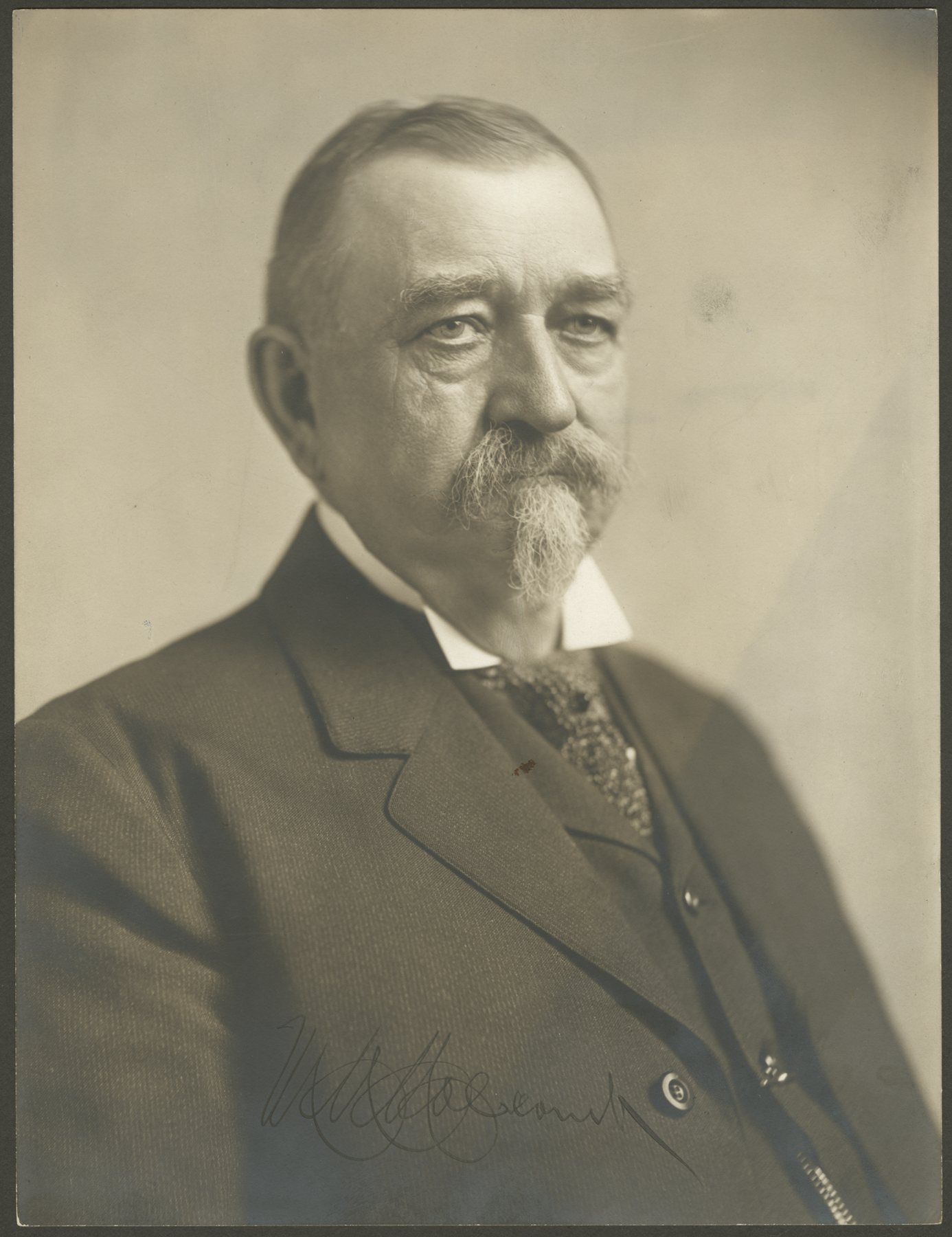
Marcus Hensey Holcomb
The Holcomb family had been in Connecticut many generations by the time Marcus Hensey Holcomb was born on November 28, 1844. Thomas Holcomb, the first of the family in America, emigrated from England to Dorchester, Massachusetts, in 1634, and later settled in Windsor, Connecticut. Carlos Holcomb, Marcus’s father, married Adah L. Bushnell, May 8, 1838, in Hartland. The family later settled in New Hartford and it was here where Marcus H. Holcomb was born. As a child, Marcus attended local schools. He went on to attend Wesleyan Seminary in Wilbraham, Massachusetts, but ill health prevented him from pursuing college. Holcomb taught school while he studied law in the office of Jared B. Foster of New Hartford. On November 15, 1871, he was admitted to the bar, and he began practice in Southington the following year. In 1893, Holcomb and fellow attorney Noble E. Pierce formed the law practice, Holcomb & Pierce, with offices in Southington, Hartford, and Bristol. Holcomb continued in the practice until 1910, while also pursuing a long and active life of political service.
| Born: | November 28, 1844, New Hartford, CT |
| College: | None |
| Political Party: | Democrat; Republican |
| Offices: | Judge, Southington Probate District, 1873-1910 |
| Treasurer of Hartford County, 1893-1910 | |
| Connecticut General Assembly, Senate, 1893 | |
| Speaker, CT House of Representatives, 1905-1906 | |
| First Judge, Borough Court of Southington, 1906-1909 | |
| Connecticut Attorney General, 1907-1910 | |
| Judge, State Superior Court, 1910-1914 | |
| Governor of Connecticut, 1915-1921 | |
| Died: | March 5, 1932, Southington, CT |
Marcus Holcomb married Sarah C. Bennett, the daughter of Joseph L. and Sarah C. (Weaver-Johnson) Bennett in Hartford on October 16, 1872. Marcus and Sarah made their home in Southington. Sarah was an active member in the first Baptist church and became involved in Sunday school work. They had one child, Marcus Hensey II, but he died in infancy.
In 1873, Holcomb was elected a Judge of the Probate Court of the Southington District, an unusual honor for someone under 30 years old. In 1893, he became a member of the State Senate, and served one term. He was also Treasurer of Hartford County from 1893 to 1910, and First Judge of the Borough Court of Southington from 1906 through 1909.
After twenty-nine years of marriage, Marcus’ wife Sarah passed away on December 3, 1901. Her funeral took place at the Holcomb home in Southington, and was attended by many relatives and friends. She is buried in the Oak Hill Cemetery in Southington, next to their son Marcus Hensey II.
In 1902, Holcomb was chosen as a delegate from Southington to the state Constitutional Convention. In 1905, Holcomb served as Speaker of the House of Representatives. At the Republican State Convention in 1906, he was selected as the candidate for Attorney General. He went on to win the election against Democratic candidate William B. Stoddard by 1,410 votes.
In 1909, Governor Frank B. Weeks nominated Holcomb to be Judge of the State Superior Court. He resigned as Attorney General to take up this position. He served as Judge of the Superior Court from 1910 to 1914, at which time he reached the court’s mandatory retirement age of 70.
Holcomb was a Democrat until 1888, when his feelings about tariff issues caused him to change parties and become a Republican. After his retirement from the Superior Court, Holcomb had no plans to run for office again. However, J. Henry Roraback, the new chairman of the Republican Party, convinced a reluctant Holcomb that his party needed him to run for governor and that he would win. In the 1914 election he ran against Democratic opponent Lyman Tingier, gaining 91,262 votes to Tingier’s 73,888, and became the forty-eighth governor of Connecticut.
Once in office, Holcomb discovered that he enjoyed being governor and ran for reelection in 1916 and 1918, becoming the State’s first three-term Governor since the adoption of the biennial term. During the six years that Holcomb was governor the General Assembly passed acts that established a retirement program for teachers, created a health insurance program, and limited the hours that women were allowed to work in factories. However, a major part of his time in office was taken up with Connecticut’s role in World War I. Holcomb became a “War Governor” and was sometimes compared to William Buckingham (Civil War) and Jonathan Trumbull, Sr. (Revolution). One of his ceremonial tasks was to visit Lebanon, Connecticut, during the war to honor those former governors and their birthplaces there.
During Holcomb’s administration, the State energetically contributed to the war effort. Holcomb prepared by creating a complete census of men and materials, appointing a State Council of Defense and a Food Supply Council, and creating a Home Guard, which at the end of 1917 had 20,000 men, 10,000 of whom were armed, equipped, and trained. In September of 1918, Holcomb hosted a luncheon for members of the French Army Band. The reception was held in the State Library’s Memorial Hall where Holcomb’s portrait was already on display.
After the war, a major issue in the United States was an amendment to the Constitution that would allow women to vote. On June 4, 1919, the United State Congress voted to approve the Nineteenth Amendment and sent the bill to the states for ratification. When it came time for Connecticut to vote on this amendment, the Legislature was not in session and Holcomb refused to have it meet because he did not see this vote as constituting an emergency. This angered those who supported Women’s Suffrage and led to an effort to force the governor to act. However, only after the Nineteenth Amendment became law did he call a special session, and this was only to develop a mechanism so that the new voters could be registered in time for the next election.
Holcomb chose to leave office rather than run for a fourth term. He remained active in his business and private interests, one of which was as president of the Southington Savings Bank. He remained close to Roraback and other party leaders and was known to them as “Uncle Marcus.”
Governor Holcomb passed away March 5, 1932, at his home in Southington. Former Governor Charles A. Templeton paid tribute to Holcomb as a “man of great personal magnetism and one that everyone loved.” 1 Governor Holcomb’s obituary goes on to say, “No man loved his State more or knew it and its people better. He was a true son of Connecticut, not by birth alone but in loyalty, and in spirit and understanding. He was a wise man, a truly great man and a very gentle man.”
On the day of his funeral, town offices in Southington were closed. Holcomb is buried next to his wife in the Oak Hill Cemetery in Southington. His home on Main Street is now a Masonic Lodge. Holcomb Hall at the University of Connecticut is named after him.
1 “Gov. Holcomb Funeral Will Be Tuesday.” The Hartford Courant, March 7, 1932, p. 4
Burpee, Charles W. History of Hartford County, Connecticut, 1633-1928. 3 vols. Chicago: S.J. Clark, 1928, vol. 3, pp. 5-6 [CSL call number F 102 . H3 B8 1928].
Connecticut State Council of Defense. Souvenir of the Pilgrimage of Connecticut’s Third “War Governor” to the Homes of the First and Second “War Governors” and Other Scenes of Historic Interest … Westerly, RI: Stedman Press, 1918 [CSL call number Conn Doc St291 so].
Connecticut Supreme Court of Errors. “Obituary Sketch of Marcus H. Holcomb,” Cases Argued and Determined in the Supreme Court of Errors of the State of Connecticut. CT : Saybrook Press, 1976-1983, vol. 115, pp. 735-736 [CSL call number KFC 3645 .A2].
Crofut, Florence S. Marcy. Guide to the History and the Historic Sites of Connecticut. New Haven, Yale University Press, 1937 [CSL call number History Reference F 94 .C88 1937].
“Death of Judge Holcomb’s Wife.” The Hartford Courant, Dec. 4, 1901, p. 2; digital images, Historical Hartford Courant, 1764- 1922 (http://www.proquest.com/ : 20 Oct 2009).
“French Army Band Guests of the City.” The Hartford Courant, Sept. 17, 1918, p. 3; digital images, Historical Hartford Courant, 1764-1922 (http://www.proquest.com/ : 20 Oct 2009).
“Funeral of Mrs. Holcomb.” The Hartford Courant, Dec. 6, 1901, p. 12; digital images, Historical Hartford Courant, 1764-1922 (http://www.proquest.com/ : 20 Oct 2009).
“Gov. Holcomb 87, Dies in Southington.” The Hartford Courant, March 6, 1932, p. 1; digital images, Historical Hartford Courant, 1923-1984(http://www.proquest.com/ : 20 Oct 2009).
“Gov. Holcomb Funeral Will Be Tuesday.” The Hartford Courant, March 7, 1932, p. 4; digital images, Historical Hartford Courant, 1923-1984(http://www.proquest.com/ : 20 Oct 2009).
“Hartford’s Vote; 1,000 Plurality on State Ticket.” The Hartford Courant, Nov. 7, 1906, p. 3; digital images, Historical Hartford Courant, 1764-1922 (http://www.proquest.com/ : 20 Oct 2009).
Highways & Byways of Connecticut. Hartford: G. Fox & Co., [1947] [CSL call number F 94 .H54 1947].
Holcomb, Marcus. “Connecticut in the Van,” American Monthly Review of Reviews LVII (May, 1918), New York, Review of Reviews, 1907-1928, [CSL call number Z 9999 .R48].
McPherson, Hannah Elizabeth Weir. The Holcombes, Nation Builders – Their Biographies, Genealogies and Pedigrees. Washington, 1947 [CSL call number CS 71 .H725 1947].
Marcus Hensey Holcomb. [S.I. : s.n., 1932] [CSL call number Special Collections F 100 .H68 M37 1932].
Pallante, Martha. “Nineteenth Amendment to the U.S. Constitution: Document Analysis.” Milestone Documents in American History. Schlager Group, 2008; digital images, Salem History, Salem Press (20 Oct 2009).
Sobel, Robert and John Raimo. Biographical Directory of the Governors of the United States, 1789-1978. Westport, CT: Meckler Books, 1978 [CSL call number GIRS Reference E 176 .B573].
State Archives Record Group 005, Records of the Governors. Please see the Rules and Procedures for Researchers Using Archival Records and Secured Collections Materials.
Van Dusen, Albert E. Connecticut. New York: Random House, 1961 [CSL call number History Reference F 94 .V3].
45” x 57” in its frame, painted ca. 1915 by Bessie Maie Weaver, who was the governor’s niece.
Originally prepared by David O. White, Museum of Connecticut History, Connecticut State Library. Edited and revised by CSL Staff, October 2009.